The PSA
recently announced that they will be conducting a four month trial into
lowering the height of the tin for women’s professional tour events, aligning
it with the men’s. Up until now, the women have been playing with 19 inch tins
– the same height as what we do here at the DAC - the professional men play
with 17 inch tins.
A lower
tin encourages more attacking squash, players can risk going short more often.
The men’s game has proven a lower tin makes for more exciting matches, the game
is faster and more dynamic than ever before. It also shortened the average
length of the contests, which together with the change in scoring to 11 points
per game (from 15) was a positive thing - because beforehand, match times were
consistently well over an hour, tournaments dragged on, and spectators could
only watch so much. But is this the right strategy for the women’s game?
One of the
arguments bought up against lowering the tin had to do with the length of the
matches. In fact, it was even suggested that
raising the tin for women’s’ squash should be a consideration, not lowering
it. At the recent Pan-Am Games (using a 19 inch tin), every match in the
women’s bracket was considerably one-sided. There were 14 matches total, the
longest being 30 minutes, four of them 20 minutes or shorter, only 2 matches
were 3-1 as opposed to 3-0, of the 44 total games that were played, 27 of them
had a score line of 11-5 or lower, and the average match length was 23.7
minutes. (1 match on the draw sheet did not have a time listed). The final took
22 minutes. That’s hardly a stellar report card from a sport that boasts to be
one of the more grueling in the world.
The men on
the other hand averaged 47 minutes per match, the longest was the final at 88 minutes
(4 games only), the shortest 17 minutes. Seven of the 15 matches went to 4 or 5
games. That certainly seems a lot more acceptable and viewer friendly.
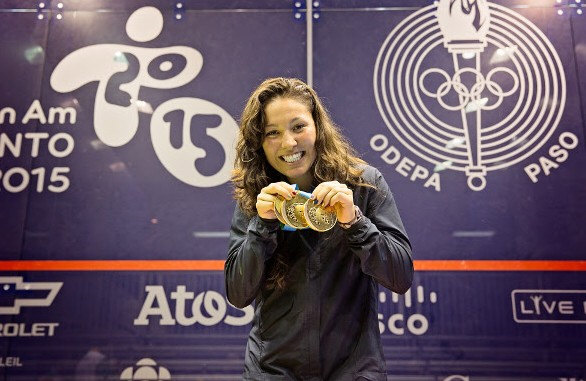 |
| Amanda Sohby with her gold medal haul. |
What I
think the stats above indicate is simply the mismatches in the women’s draw for an event such as the Pan-Am’s
The USA women dominated the event. American Amanda Sohby won the gold medal.
She is ranked 10 in the world. She beat compatriot Olivia Blatchford in the
final – ranked 38 in the world. Amanda’s quarter final opponent is ranked 87 in
the world. Olivia’s quarter final opponent isn’t even on the ranking. With
disparities such as these – and there were many of them – no wonder the matches
were done so quickly.
The
match-time argument against lowering the tin was based solely on the Pan-Am’s
results. A non-world ranking event that pitted ‘no names’ against a small
sample of world ranked players. Not exactly a wide spread selection of women’s
tournaments to make such an assertion regarding the height of the tin. So I
went back to look over at some major women’s events in the past 12 months to
see if in fact their matches were following a similar trend to the Pan-Am’s.
(On occasion, some matches did not have a time listed. They are not counted in
the calculations.)
1.
U.S
Open from Oct 9-18, 2014.
Women
averaged 42.8 minutes a match.
Longest match was 76 minutes – a first round encounter. Shortest match was 26
minutes. That’s 3 minutes longer than
the Pan-Am average. Final was 41 minutes and was only 3-0. Two of those games
were 12-10.
The
men averaged 54 minutes here. This
event had equal draw size and prize money for men and women. The US Open plays
no favorites. Longest match – 95 minutes (first round) and shortest was 27
minutes. The final was only 5 minutes longer than the women’s final at 46
minutes – it was 3-1. Had the women’s final gone to 4 games, it would no doubt
have been longer then the men’s.
2.
Women’s
World Championship from Dec 12-20, 2014.
Average
match time was 47 minutes. The final
was 66 minutes, the longest recorded match of the event was 80 minutes which
was in the first round. The shortest match was 24 minutes – still longer than
the Pan-Am average.
Men’s
World Championship from Nov 13-21, 2014
Average
match length was 49 minutes. Just 2
minutes longer than the women’s. The men had a 64 draw to the women’s 32, so
they did have a more matches to play. The longest match of the event was 99
minutes – also in the first round. The final took 90 minutes. The shortest
match was technically 8 minutes long, but that was because of an injury,
otherwise it was 24 minutes – same as the women’s.
3.
Tournament
of Champions from Jan 14-024, 2015.
Women’s
average match time was 46.8 minutes.
Longest match was 76 minutes in the semi final. Shortest match was 23 minutes.
Same as the Pan-Am average. The final was four games and took 48 minutes.
For
the men, the average time was significantly higher. At 65.2 minutes a match, also take into consideration the bigger draw
– 32 as opposed to 16 for the women. The longest match here took 121 minutes
(Miguel Rodriguez!) and the shortest took 31 minutes. The men exhausted
themselves for this event. 16 of the 31 matches took over hour. The final was
83 minutes.
4.
Windy
City Open from Feb 27 – Mar 4, 2015
Like
the US Open, the draw sizes and prize money for both men and women are the
same. The women averaged 41 minutes
a match here. The longest match was 65 minutes, the shortest 22 minutes. The
final was 3-1 in 57 minutes.
The
men had an average of 56.4 minutes.
Longest match was 101 minutes and the shortest was 23 minutes (not counting a 9
minute shortened match due to injury). The final was a 3-0, 62 minute
encounter.
5.
British
Open from May 9-17, 2015
The
women averaged 45 minutes a match.
Longest encounter was a 77 minute semi final, the shortest was 24 minutes. The
final was 51 minutes for 4 games. Interestingly, the average length of the
quarter finals were longer than the men’s quarters, and the semi finals were
just about the same.
The
men’s average was 54.3 minutes. The
final was the longest match at 93 minutes, 11-5 in the 5th result.
The shortest was 28 minutes if you don’t count a 26 minute first round match
that was cut short with an injury.
6.
Alexandria
International from 4-10 July, 2015
This
was a women’s only event. Average match time was 41 minutes. 65 minutes was the longest match from the semi final
and the shortest match was just 20 minutes. 14 of the 31 matches were 3-1 or
3-2.
Obviously
this is hardly a scientific study, but it does appear that the trend for the average
length of women’s matches in these major events hovers between 40-50 minutes.
As expected, the men’s matches average longer, although with exception to the
Tournament of Champions, not significantly so. I also went through a handful of
random smaller women’s events on the calendar and many of these averages
dropped considerably. The lowest average I found was 26.8 minutes per match (6
of 15 matches were under 20 minutes), and quite a few others that were around
30-35 minutes, the highest – 49 – seemed to be an anomaly. Nothing else I found
came close to that.
Conclusion?
If you take for a fact the lowering the height of the tin will shorten the
matches on average (which is the general consensus), maybe it is not a good
idea for the women to go there… yet. What do you think the reaction would be if
the average match time for major events started to get below 40 minutes, and
for the smaller tournaments, consistently below 30? Will sponsors be interested
in pouring money into contests that are finished in the same time as half an
inning of baseball, or where the action takes less time to watch than the
commercials that support it? Should a game of squash take less time than a game
(not set) of tennis?
I think
raising the tin is out of the question – and I’m not sure the person who did
propose that was being completely serious – but lowering it may damage the
women’s game more than help it. This also got me thinking in regards to the
recent push of trying to get equal prize money for women. With the risk of
sounding utterly misogynistic, if the women deserve to be paid the same then
shouldn’t the workload be similar – same draw sizes, similar match times. Right
now, the disparity between the men’s and women’s average isn’t overly
substantial in major events, but if it gets to a point where the men are on
court significantly longer than their counterparts, then in the end women would
actually be earning a lot more (per hour)… fair? Unquestionably you cannot
predict the length of any match, but men’s matches – even with the lower tin –
are already longer than the women’s. Lowering the women’s tin, I fear the
difference would be too pronounced.
In short, based
on the above data. I believe the tin should remain where it is. For now. The
women’s game is improving –
especially with the rise of some of these young stars like Raneem El Welily, Camille
Serme, Nouran Gohar, and Amanda Sohby just to name a few. It might not be too
far away when the need to lower the tin would make more sense, until then maybe
the PSA shouldn’t be rushing into this all in the name of equality.


.jpg)


